In the dawn of the 20th century, cinema was a new art form, comprising many techniques that hadn’t been developed. And the ones that had had not been studied to the needed extension. The elements of editing were among them. Filmmakers knew that you could cut and splice the film strip, but they didn’t thoroughly comprehend the purposes of doing so.
Lev Kuleshov, a Soviet filmmaker, was among the first to dissect the effects of juxtaposition. Through his experiments and research, Kuleshov discovered that depending on how shots are assembled the audience will attach a specific meaning or emotion to it.
In his experiment, Kuleshov cut an actor with shots of three different subjects: a hot plate of soup, a girl in a coffin, and a pretty woman lying in a couch. The footage of the actor was the same expressionless gaze. Yet the audience raved his performance, saying first he looked hungry, then sad, then lustful.
From the video demonstration of the Kuleshov effect in use, the character can be split into two contrasting perspectives. For example, the man is seen to be smiling at a bowl of soup - then he is seen to be smiling at a child in a coffin. This use of the Kuleshov effect is most common - that contrasts the different personalities. The experiment outlined that the audience subconiously create a link that the man must be hungry (looking at soup), grieving (looking at coffin) or sexually aroused (looking at a woman.) The results from this experiment connote the fact that the audience subconcious thought process is able to create links with one focus and another by using film.
The video above features the Kuleshov effect being put into use in films. The narrator briefly explained what the Kuleshov effect is and outlined the experiments that Lev Kuleshov conducted using film at the beginning of the 20th Century. However, the narrator cuts a video of a man smiling and looking at the baby. The audience make a subconcious judgement that the man is a caring individual and likes children. Then, the narrator cuts the same video of the man smiling - however this time the editor has cut a video of strippers etc. at a club. The inference (of the man) that the audiences subconious make is that he is a 'sexual deviant.' This modern day comparison and re-evaluation supports that the Kuleshov effect is still valid in the editing process.
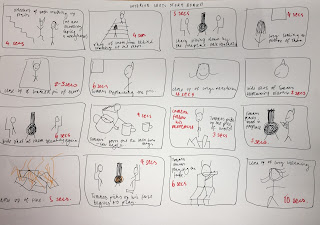
Alfred Hitchcock Loves Bikinis Alfred Hitchcock explains briefly that the film can be edited to contrast a character in two completely different ways. For example, Hitchcock can be seen smiling at a child - this infers the character loves children and is a gentleman. However, when the focus of the man changed to a woman in a bikini, Hitchcock was portayed as a 'sexual deviant.' Two different prejudices are immediately formed. This is also known as the Kuleshov effect. The storyboard for the recreation of 'Alfred Hitchcock Loves Bikinis.' The remake focused on LGBT prejudice and discrimination as the group felt that the main issues that youth (that are part of the community) face is hate crime, institutional discrimination and bullying. The footage was filmed in the Sixth Form cafe, meaning the group was not required to calculate the expenses of filming in an abstract location - as well as this the location suited the context of the film. Character ...
Mise en Scene; Indiana Jones Costume The costume of Indiana Jones replicates an arachaeologist or adventurer. This aspect of his costume infers that his character has some mid to high experience of the setting. The colours of the costume portray some element of camoflage and appropriation to the setting - which would be typical of a standard archaeologist or adventurer. However, the secondary character, dressed in the polar opposite of what the main character is seen to be wearing. This character is wearing a leather jacket, presumably jeans and converse shoes. This gives off the impression that he is an average teenager and does not know alot about the topic that the main character is persuiting. Lighting The primary source of lighting in this scene is the large light, underneath the secondary character. The purpose of this was to create an element of front lighting. Also, the colour of this lighting is white, which indicates that the characters are exploring an unknown c...
Comments
Post a Comment