-Boxes insinuating parcels: in the outside scene, Mr tumness is seen holding an armful of parcels. To make these I used a flat piece of cardboard and within, cut out a net. I then put together the net and wrapped them in paper to make it look as though they are parcels
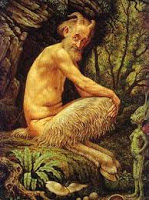
-A picture of an older faun: I found it hard to find a good picture of a faun but after looking on google images I came across this picture which was the most appropriate. the picture quality is quite low and therefore in the shot we will make sure that the photo isn't fully and is briefly shown on camera.
-A flute: in Mr Tumnus' house he begins to play a flute for Lucy which instigates her seeing the wonders of Narnia. Because of this, we will need a flute to show Mr Tumnus playing it in this scene. Luckily, one of the makers of the short film has a flute so we will use this to our advantage and use it in the scene rather than having to source or buy one.
-Snow: we originally were going to use snow in the outside scenes, unfortunately this would've been hard to do as it would've been hard to make and as it was a public place it would've left a mess. because of these reasons we decided not to make snow.
-lamp post: in the script, a lamppost is shown in Narnia. As this was a short production with limited time and resources we were unable to make a lamppost to resemble the famous lamppost in the original script.
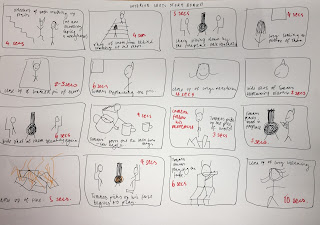
Alfred Hitchcock Loves Bikinis Alfred Hitchcock explains briefly that the film can be edited to contrast a character in two completely different ways. For example, Hitchcock can be seen smiling at a child - this infers the character loves children and is a gentleman. However, when the focus of the man changed to a woman in a bikini, Hitchcock was portayed as a 'sexual deviant.' Two different prejudices are immediately formed. This is also known as the Kuleshov effect. The storyboard for the recreation of 'Alfred Hitchcock Loves Bikinis.' The remake focused on LGBT prejudice and discrimination as the group felt that the main issues that youth (that are part of the community) face is hate crime, institutional discrimination and bullying. The footage was filmed in the Sixth Form cafe, meaning the group was not required to calculate the expenses of filming in an abstract location - as well as this the location suited the context of the film. Character ...
Mise en Scene; Indiana Jones Costume The costume of Indiana Jones replicates an arachaeologist or adventurer. This aspect of his costume infers that his character has some mid to high experience of the setting. The colours of the costume portray some element of camoflage and appropriation to the setting - which would be typical of a standard archaeologist or adventurer. However, the secondary character, dressed in the polar opposite of what the main character is seen to be wearing. This character is wearing a leather jacket, presumably jeans and converse shoes. This gives off the impression that he is an average teenager and does not know alot about the topic that the main character is persuiting. Lighting The primary source of lighting in this scene is the large light, underneath the secondary character. The purpose of this was to create an element of front lighting. Also, the colour of this lighting is white, which indicates that the characters are exploring an unknown c...
Back to the Future I Marty McFly, a typical American teenager of the Eighties, is accidentally sent back to 1955 in a plutonium-powered DeLorean "time machine" invented by a slightly mad scientist. During his often hysterical, always amazing trip back in time, Marty must make certain his teenage parents-to-be meet and fall in love - so he can get back to the future. Marty McFly, a 17-year-old high school student, is accidentally sent thirty years into the past in a time-traveling DeLorean invented by his close friend, the maverick scientist Doc Brown. Written by Robert Lynch Theatrical Trailer for film